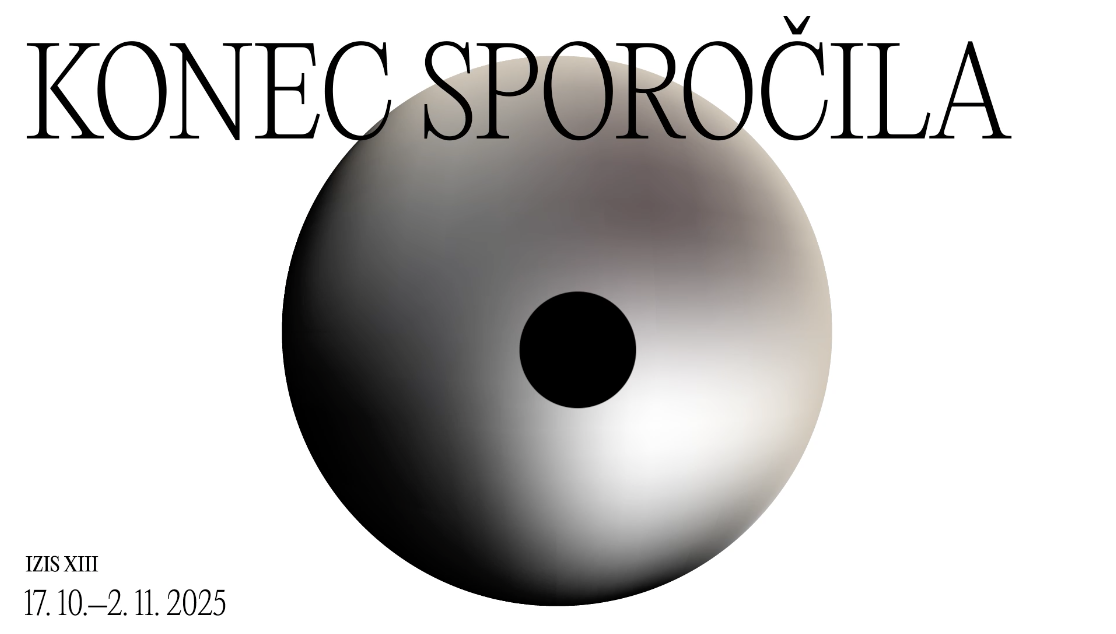

Festival IZIS 2025: End of Message
Date: 17. 10. – 2. 11. 2025
Location: Galerija Loža, Palača Gravisi-Buttorai, Utrdba Bastion
The thirteenth edition of the IZIS Intermedia Art Festival, titled "End of Message," explores information noise and the (in)ability to communicate in the era of communicative capitalism. The festival asks what happens to a message within a mass of disinformation, fake news, and the hyperinflation of machine-generated images—and whether a message in such an environment can even reach its recipient.
"The most powerful media organizations of the twenty-first century will be thermal. The circulation of images, sounds, videos, and texts will depend on an extensive regime of heating and cooling. Data and networks, like the people they connect, will become increasingly fragile. If it gets either too hot or too cold, platforms will crash. Digital infrastructure—data centers, network exchanges, and fiber-optic cables—will drain the planet's energy to create a stable thermal environment—not for people, but for information." — Nicole Starosielski, Media Hot and Cold, 2022
Curatorial Statement: Irena Borić
The thirteenth edition of the IZIS Festival takes information noise as its theme, exploring the (in)abilities of communication within communicative capitalism. It questions the fate of the message amidst post-truths, disinformation, and fake news, as well as the hyperinflation of content generated by machines, such as bots or artificial intelligence. How do rumors, advertisements, recommendations, viral videos, and private or public footage from war zones or disaster sites affect the message circulating in the same communicative space?
The answer may depend on the perspective from which we understand the message. From a human perspective, the content is influenced by cultural, linguistic, and other factors; for machines, it is merely a matter of calculation. According to one of the earliest communication frameworks, the Shannon–Weaver model, background noise contextualizes information, and information requires noise for successful transmission. In other words—without noise, there is no information.
At the same time, receiving information or perceiving it is not the same as a precise understanding of the external world. As artist and writer Trevor Paglen notes: "[...] the gap between what we feel and what we perceive can be filled with all kinds of direct injections and contradictory hallucinations. Reality thus becomes a rather complicated mess of the material, the imaginary, the perceptible, and the imperceptible—all of which can be manipulated." What happens to meaning if a message circulates in an environment where new forms of media, as Paglen writes, "[...] produce and persuade, modulate and manipulate, shaping worldviews and actions to convince us of what they want us to believe, and to extract value and influence from them."
"End of Message" (EOM) is a standard marker for the conclusion of email correspondence, signifying a message that expects no reply. Within this year's IZIS, "End of Message" becomes a metaphor for broken, meaningless, and interrupted communication—one that neither accompanies a dialogue nor requires a recipient for its existence. The endless proliferation of content that may never reach an addressee merely illustrates the subordination of communication to economic logic. Quantity drowns out quality.
In this mechanical performance, everyone participates—from humans to bots and generative AI—simultaneously mimicking one another without knowing who is talking to whom. In this hyper-profitable environment, one can smell the "rot of the internet corpse," adapting to the priorities of individual platforms that ultimately shape digital subjectivity. Thus, despite being intimately familiar with images and records of the genocide in Palestine, political action to prevent it remains paralyzed; the information simply is. It expects no action. Instead, as James Bridle writes in New Dark Age: "[...] information and violence are completely and inextricably linked, and the technologies intended to exert control over the world are accelerating the weaponization of information. Even though the consequences are visible everywhere, we continue to overvalue information, locking ourselves into repetitive cycles of violence, destruction, and death."
Ironically, precisely because the sphere of data and information is built on the abstract time and space of capital, the material consequences of communication infrastructure threaten the fundamental conditions of life. Access to cheap energy not only presupposes the potential for human conflict but also results in a massive carbon footprint, pollution, e-waste, and the mining of raw materials.
Therefore, the "End of Message" addressed by the festival also encompasses the material layer that makes the message possible. This time, the focus is not solely on the material conditions of information production, but on unfolding various facets of (mis)understanding from diverse human and more-than-human perspectives.
Več informacij in program: https://festival-izis.org/en/end-of-message/