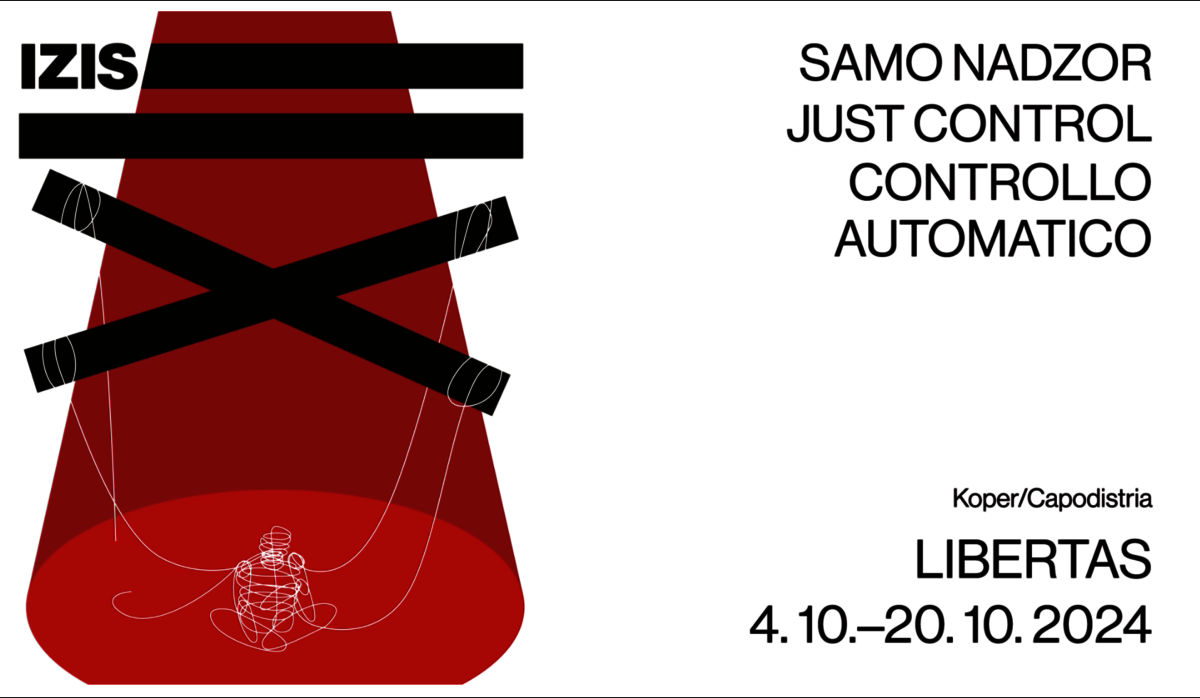

Festival IZIS 2024: Just Control
Date: 4.–20. October 2024
Location: Skladišče Libertas, Koper
Curator: Irena Borić
The twelfth edition of the IZIS Intermedia Art Festival, titled "Just Control" (Samo nadzor), explores the complex relationships between autonomous and hierarchical control. The festival interrogates the contradictions of contemporary society, where we exist under constant surveillance yet, paradoxically, often feel secure within it.
Curatorial Statement: Irena Borić
The twelfth edition of the IZIS Festival unfolds the theme of control through its exhibition and performance programs, questioning the inherent contradictions of the concept. With the title Samo nadzor, the festival captures the dialectic between autonomous and hierarchical control; meanwhile, the Italian and English translations—Controllo automatico and Just Control—aim to add further layers to the term. The featured artists address (self-)control through environmental, meteorological, data-driven, gamified, and mechanical systems, thereby deconstructing its precarious duality.
In an era of "free-floating" surveillance, we are under more control than ever before, yet surprisingly, we can feel relatively carefree—even safe. This may be due to the withdrawal of the "site" of surveillance, as it can be found everywhere and nowhere simultaneously. In psychological terms, the locus of control is key to understanding how an individual perceives the causes of events in their life. An internal locus exists if a person believes they can control their own life, while an external locus emphasizes the belief that control comes from the outside—from the environment or others. The sense of control carries different weights depending on its placement: internal control gives the impression of taking responsibility for one's life, whereas external control points toward a sense of powerlessness.
Can the digital environment be understood as an internal locus of control within an expanded field, where individuals frequently reveal their intimacy—ranging from personal data to personal fears? How is this facilitated by the ubiquity of networks, which embed hybrid devices into every pore of society—political, economic, cultural, natural, and emotional?
As theorist Alexander R. Galloway articulates in Protocol: How Control Exists after Decentralization (2004), the fundamental principle of a network is control, not freedom. Therefore, understanding how power operates in a "control society" depends on understanding the protocol, whose political economy is based on management, modulation, and control. Galloway writes:
"Technically and politically, the 'control society' derives from cybernetic research as much as from the military-industrial imperative to 'govern' information systems. This historical background sets the stage for various periodizations and mutations in the life of the protocol."
A certain mutation of the network is also contained in the concept of the "techno-social," which theorist Tiziana Terranova defines in her essay Colonial Infrastructures and Techno-social Networks (2021) as a form of the social that emerges after its own end. For the author, this is neither a virtual nor a global digital community, but an integral part of the environment created by a new technical being—the digital computer network. In the same essay, Ravi Sundaram highlights the "calculative infrastructure" of modern times, revealing that human life is highly measurable within the broader context of global shifts. Such infrastructure can bring about technologies of violence and extraction as specific forms of colonial rule, driven by racial and ethnological technologies. Thus, it extends beyond human life to encompass the wider environment.
Meteorological instruments—hygrometers, barometers, and other measuring tools—place a sense of control into the environment by gathering data that could be crucial for maneuvering through an uncertain future. At the same time, as data and instruments multiply, control becomes a mere illusion of an exit from the crisis; all the acquired knowledge and data do not prevent the melting of glaciers or the extinction of species. The dilemma lies in the fact that today, the operation of machines is increasingly autonomous, affecting human biological regulation and even the organs of bodily control. The question remains: what happens when technology becomes independent, alienated, or simply breaks down? In a calculated, vector-based environment, how is it possible to resist the cold regulation of the world?
More information and Programme: https://festival-izis.org/en/just-control/